One of the outstanding questions in fundamental physics concerns the apparent imbalance between matter and antimatter. According to our current understanding, the Universe should have been born with nearly equal amounts of both. Whenever a particle meets its antiparticle, the two annihilate into radiation. If matter and antimatter had been produced in exactly equal quantities in the early Universe, they would have largely disappeared, leaving behind a cosmos filled almost exclusively with light. Yet the very existence of stars, planets, and life demonstrates that a small excess of matter must have survived. Understanding the origin of this asymmetry is one of the central goals of modern particle physics and cosmology.
The Standard Model of particle physics does contain a mechanism capable of distinguishing matter from antimatter through the phenomenon known as CP violation. This effect has been observed experimentally in processes governed by the weak interaction, where quarks can transform from one type to another. The amount of CP violation predicted and measured in the weak sector, however, appears to be far too small to account for the overwhelming dominance of matter in the Universe. This suggests that additional sources of CP violation may exist beyond those currently known.
In contrast, the electromagnetic interaction does not naturally allow CP violation. The equations describing electric and magnetic phenomena treat matter and antimatter symmetrically and preserve CP to a very high degree. The situation is more subtle for the strong interaction, described by Quantum Chromodynamics (QCD). The theory permits the existence of an additional term that would violate CP symmetry and could potentially provide a new source of matter–antimatter asymmetry. Surprisingly, however, no evidence for such strong-interaction CP violation has ever been observed. The most stringent constraints come from measurements of the electric dipole moment of the neutron. If strong CP violation were sizable, the neutron would behave as if its positive and negative charges were slightly displaced from one another, producing a measurable electric dipole moment. Decades of increasingly precise experiments have found no such signal, implying that any CP-violating effects in QCD must be extraordinarily small. Explaining this apparent absence of strong CP violation is known as the strong CP problem.
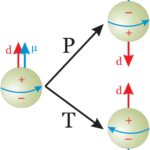
A permanent electric dipole moment of the neutron would signal CP violation in the strong interaction. Experimental measurements have constrained the neutron EDM to extremely small values, leading to the strong CP problem: why is the CP-violating parameter of QCD so close to zero?
The Chiral Magnetic Effect (CME) offers a unique opportunity to investigate this puzzle from a different perspective. In the extreme conditions created during collisions of heavy atomic nuclei, temperatures exceed those that existed microseconds after the Big Bang and magnetic fields among the strongest known in nature are generated for a fleeting instant. Under these conditions, quantum fluctuations of the QCD vacuum can induce local imbalances between left-handed and right-handed quarks. In the presence of a strong magnetic field, these imbalances lead to a separation of positive and negative electric charges along the field direction—a phenomenon known as the Chiral Magnetic Effect.
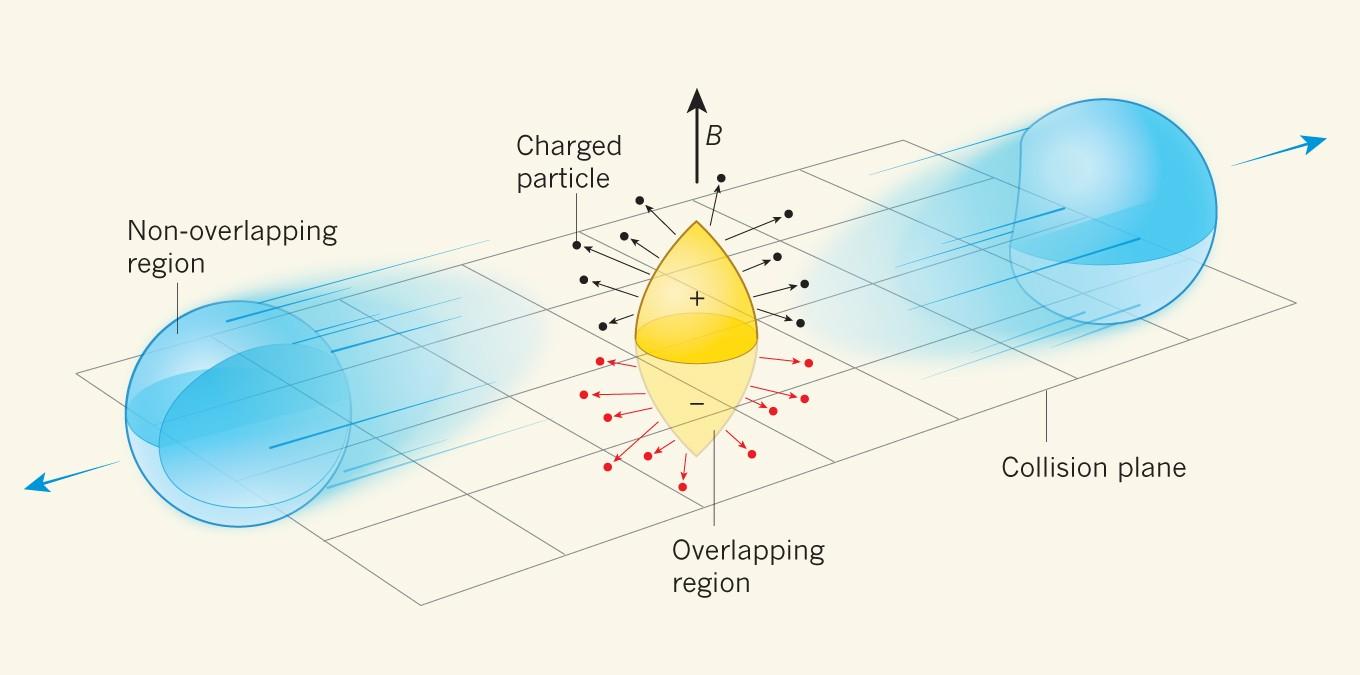
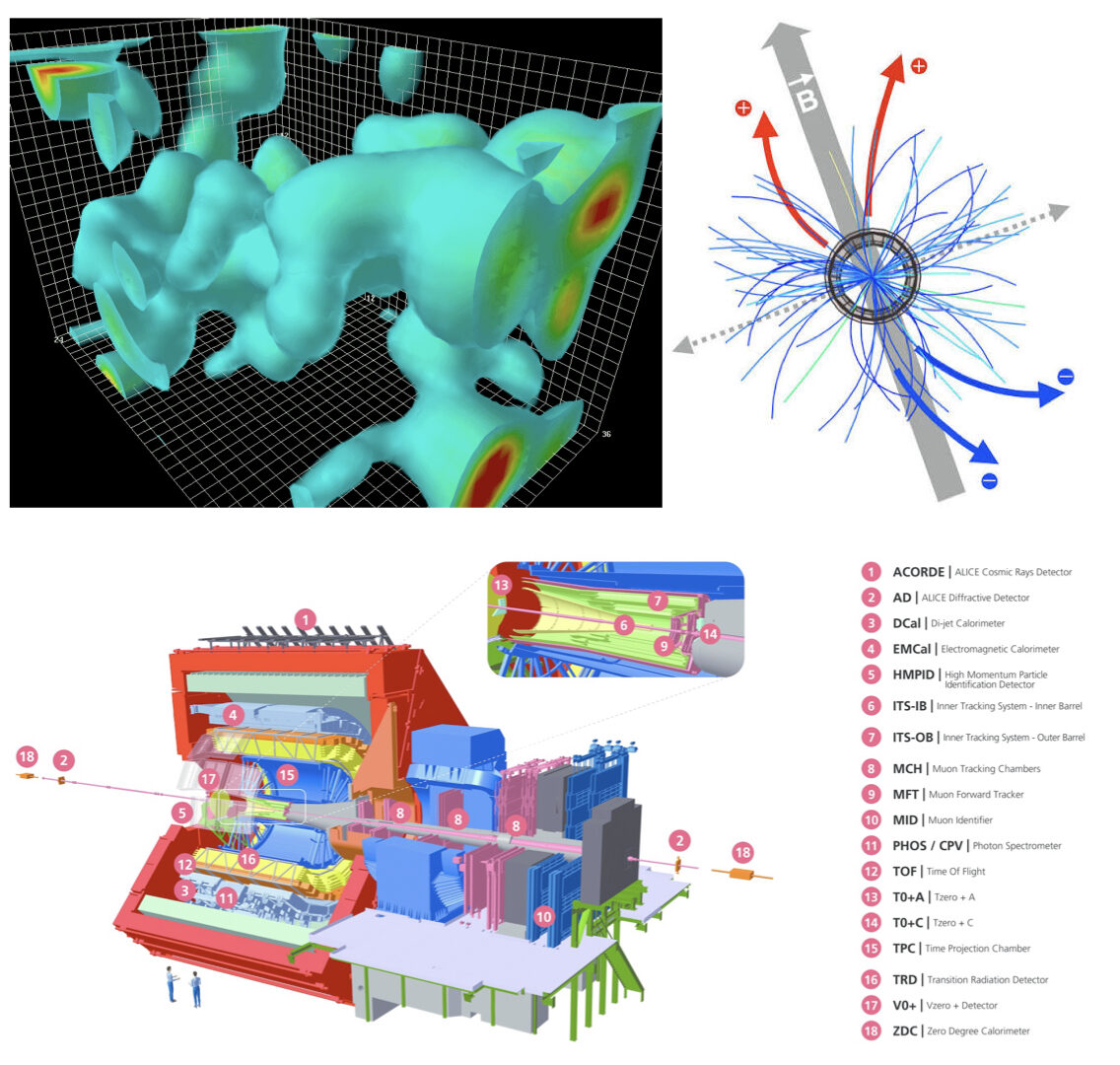
In a non-central heavy-ion collision, an intense magnetic field is generated perpendicular to the reaction plane. Local topological fluctuations in the QCD vacuum may induce an imbalance between left- and right-handed quarks, resulting in a separation of positive and negative charges along the magnetic field direction—the Chiral Magnetic Effect.
What makes the CME particularly exciting is that it provides an observable consequence of the topological structure of the QCD vacuum and its associated CP-violating fluctuations. Although global CP violation in the strong interaction appears to be strongly suppressed, the CME may reveal transient, local manifestations of the same underlying physics. By searching for experimental signatures of charge separation in relativistic heavy-ion collisions at facilities such as CERN and Brookhaven National Laboratory, physicists hope to gain new insight into the strong CP problem and the broader question of whether additional sources of CP violation could help explain why our Universe is made almost entirely of matter rather than antimatter.