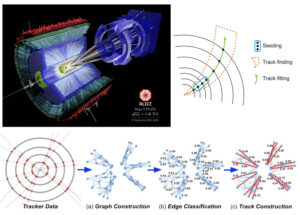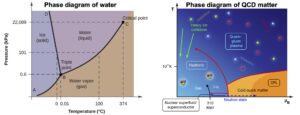
Hadronisation is the process through which the quarks and gluons produced in high-energy particle collisions transform into the observable particles detected in experiments. Although the production of energetic quarks and gluons can often be described using perturbative Quantum Chromodynamics (QCD), the subsequent formation of hadrons occurs in the non-perturbative regime of the strong interaction, where first-principles calculations are generally not possible. As a result, hadronisation remains one of the least understood aspects of particle physics and is typically described through phenomenological models that are constrained by experimental data.
Understanding hadronisation is essential for interpreting measurements at modern collider experiments such as the Large Hadron Collider (LHC). The process determines the composition and structure of the final state, affecting observables ranging from identified-particle yields and baryon-to-meson ratios to jet properties and heavy-flavour production. Hadronisation studies therefore play a central role in precision tests of QCD, searches for new physics, and the development of realistic Monte Carlo event generators. In proton–proton collisions, they also provide insight into the complex interplay between hard partonic scatterings, multiple parton interactions, and the colour fields connecting the outgoing partons.
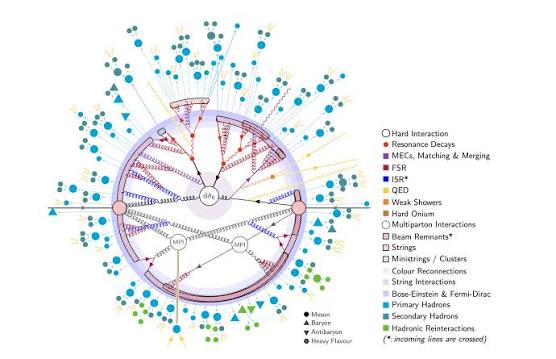
The most widely used description of hadronisation in proton–proton collisions is the Lund string fragmentation model, implemented in event generators such as PYTHIA. In this picture, colour-connected quarks and gluons are linked by strings representing the confining colour field. As the partons move apart, energy is stored in the strings until new quark–antiquark pairs are produced from the vacuum, causing the strings to break into smaller segments that eventually form hadrons. Over the years, this framework has been extended with additional mechanisms to better reproduce experimental observations. Examples include colour reconnection models with junction topologies, which provide new pathways for baryon production, rope hadronisation models where overlapping strings combine into stronger colour fields that enhance strange-quark and baryon production, and more recent close-packing approaches that account for the effects of densely populated colour fields in high-multiplicity events.
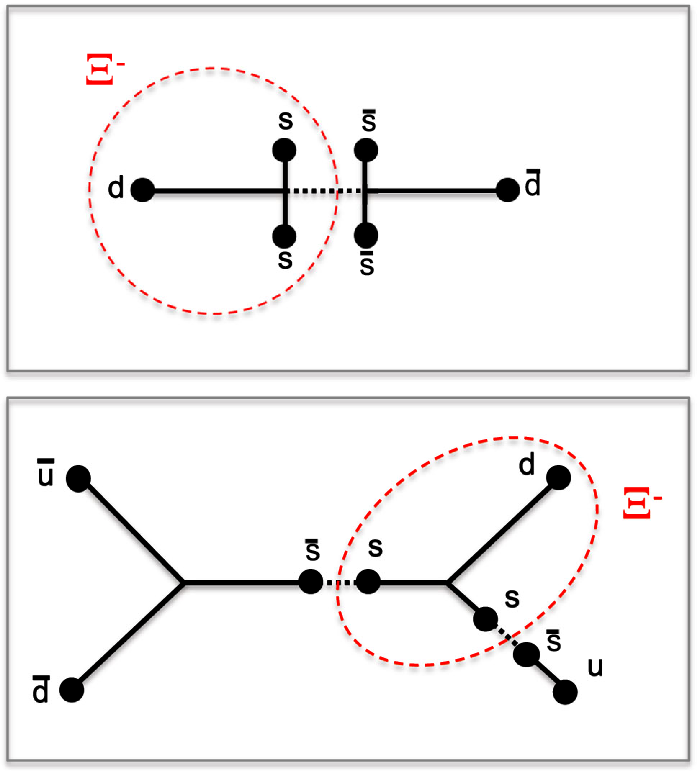
A wide variety of studies can be performed to investigate hadronisation. Traditional measurements focus on particle yields, flavour composition, and baryon-to-meson ratios, while more differential approaches examine correlations between particles carrying conserved quantum numbers such as charge, strangeness, charm, beauty, and baryon number. Heavy-flavour hadrons are particularly valuable probes because the production of charm and beauty quarks can be calculated perturbatively, allowing hadronisation effects to be studied with reduced ambiguity. Alternative mechanisms, such as quark coalescence, are often discussed in the context of heavy-ion collisions where a dense partonic medium is formed and nearby quarks can combine directly into hadrons. Although proton–proton collisions are generally well described by string-based models, the increasing evidence for collective phenomena in high-multiplicity events motivates continued exploration of whether additional hadronisation mechanisms may also contribute in small collision systems.